

Biamp Tesira
Biamp Tesira. Control in the room.
nanoblue controls the audio DSPs of the Biamp Tesira platform through the manufacturer’s interface, the Tesira Text Protocol: level, mute, source selection, logic, presets and level meters – with feedback and without touching the signal path of the DSP.

One control list makes every block operable
In a Tesira system the signal path is drawn freely: level controls, mixers, source selection, logic and meters are individual blocks, and every block has a name, the Instance Tag. The dashboard has a control list for this: one row per block that is to be operated, with name, type, Instance Tag and channel. One click fetches the names of all blocks from the DSP, another reads the current value of a row – so during commissioning it is quickly clear whether name and channel are right. The list can be saved as a file and loaded again for further installations. If a block does not exist in the DSP, the row is marked at once.
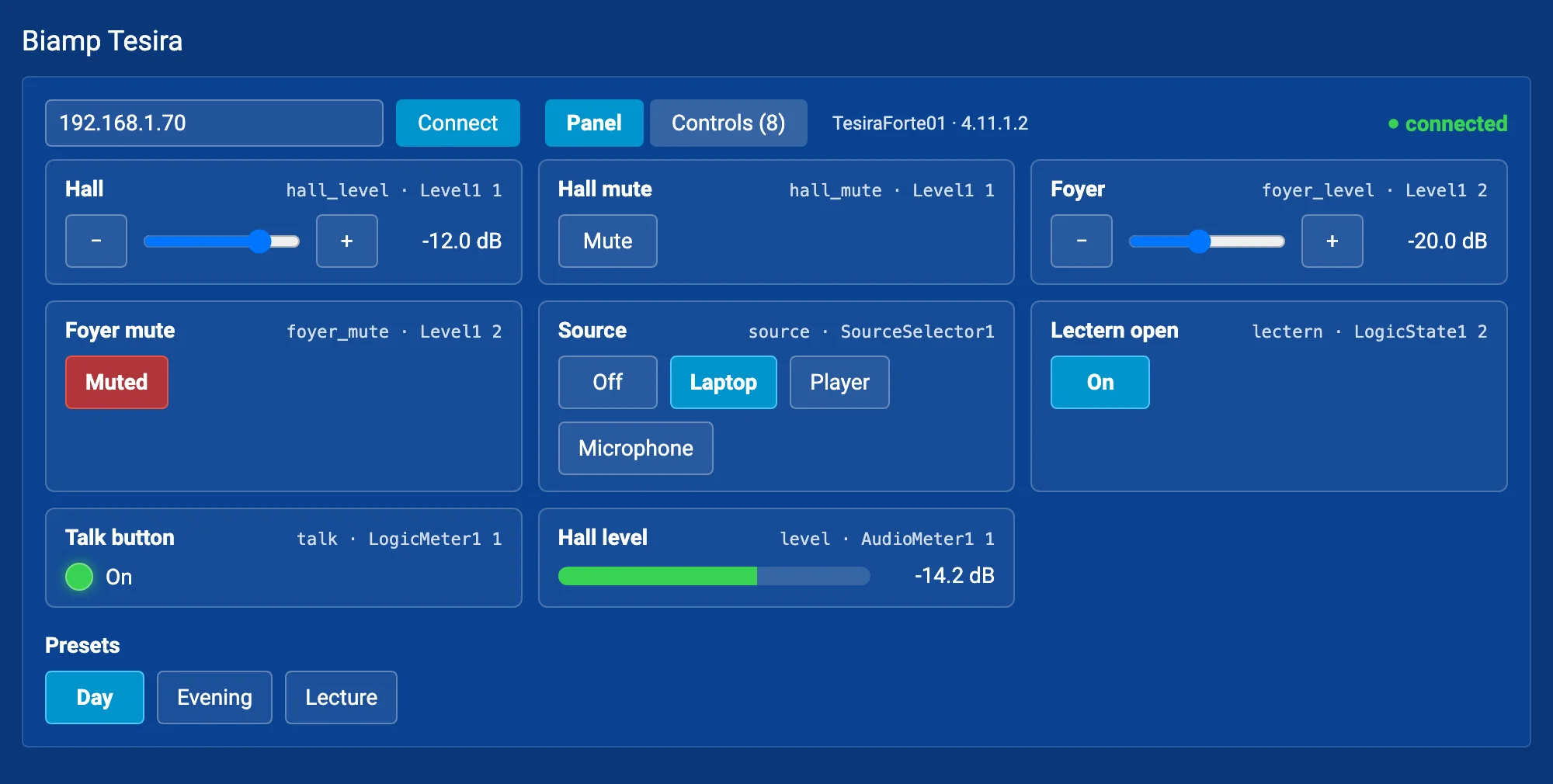
After that every block is available in the Interactive UI: sliders for levels, buttons for mute, sources, switches and presets, lamps for logic indicators, bars for the level meters. nanoblue reads the control range of a fader from the DSP. The DSP confirms every command and reports changes by itself – even when something is set in the Tesira software, on a wall panel or by a preset. Room scenes, schedule and workflows use the same functions. The connection runs via Telnet in the local network of the installation; protected systems are logged in with user and password. The control has been tested in test mode; it is verified on the device during commissioning.
- Level in dB as a slider or in steps
- Mute, source selection, switches, logic and presets by button
- Level meters and feedback, every command confirmed
- Control list per project, names read straight from the DSP
- Interactive UI via ID, no programming
One system, many brands
Netgear
Configure and monitor AV Line switches.
Learn more → 3rd Party APIDante
Audio routing across the Dante infrastructure.
Learn more → 3rd Party APIQ-SYS
Control Q-SYS cores natively via QRC.
Learn more → 3rd Party APIYamaha
Native control for DME DSPs.
Learn more → 3rd Party APIBSS Soundweb
Direct control for Soundweb London DSPs.
Learn more → 3rd Party APILinea Research
Operate and monitor M and C Series amplifiers.
Learn more → 3rd Party APISymetrix Jupiter
Operate Jupiter DSPs directly.
Learn more → 3rd Party APISennheiser
Operate and monitor ceiling, video bar and wireless microphones.
Learn more → 3rd Party APIShure
Operate and monitor the MXA920 ceiling microphone and ULX-D wireless receivers.
Learn more → 3rd Party APIEcler
Operate HUB zone managers and the eMIMO1616 matrix.
Learn more → 3rd Party APILightware
Taurus UCX switchers via REST API.
Learn more → 3rd Party APIPureLink
Switchers, matrices & VB-300-PRO video bar.
Learn more → 3rd Party APIPlexusAV
AVoIP matrix with JPEG XS & H.26x.
Learn more → 3rd Party APITurtle AV
AV over IP with Chazy 4K and Dante AV-A.
Learn more → 3rd Party APItvONE
CALICO PRO: presets and sources via REST API.
Learn more → 3rd Party APIAnalog Way
Operate LivePremier image processors from a touch panel.
Learn more → 3rd Party APIBettear
Auracast broadcast audio & assistive listening.
Learn more → 3rd Party APIGude
Switchable PDUs: measure & switch power.
Learn more → 3rd Party APIBlaze
Control & monitor PowerZone amplifiers.
Learn more → 3rd Party APIPixera
Media servers for shows & installations.
Learn more → 3rd Party APIAllen & Heath
Remote-control mixing consoles & matrices.
Learn more → 3rd Party APIAllen & Heath IP-8
IP-8 fader controller – no audio processor.
Learn more → 3rd Party APIAvonic
Pan, zoom and preset PTZ cameras.
Learn more → 3rd Party APISharp
Native control for pro displays.
Learn more → 3rd Party APIViewSonic
Operate CDE14 series commercial displays over the network.
Learn more → 3rd Party APIXilica
Control & monitor audio DSPs.
Learn more → 3rd Party APIBitfocus Companion
Link Stream Decks directly to the function logic.
Learn more → 3rd Party APIMIDI/OSC
Connecting audio worlds natively.
Learn more → 3rd Party APIDMX
Control lighting via Art-Net & sACN.
Learn more → 3rd Party APIDALI
Professional lighting control seamlessly connected.
Learn more → 3rd Party APIKNX
Building automation seamlessly connected.
Learn more →